You may find the verbatim of some other conferences in our revue GRASPE.
If you appreciate our work, please consider becoming a member of U4U.
The consequences for the EU of the war in Iran
With Guillaume Duval
14 October, 12.45 pm
Online conference in French
Link to the conference: https://u4unity.webex.com/meet/jps
The conference will not be recorded; a verbatim transcript will be published in the journal GRASPE.
More than seven months after the start of the war launched by Donald Trump against Iran, the consequences for Europe and Europeans have been massive and extremely negative. What, specifically, are these consequences? What is the EU doing, and what could it do, in such circumstances?
What it takes to be yourself
With Mrs. Pinuccia Contino
Thursday 15 Oct – 12.30–2.00
Online conference in English
Link to the conference: https://u4unity.webex.com/meet/jps
Pinuccia Contino is Deputy Director at the European Commission, where she heads the unit responsible for gender equality. Previously, she was responsible for consumer protection and product safety. Driven by a deep exploration of life’s purpose and personal fulfilment, Pinuccia studied compassion at Stanford University and trained in compassionate leadership.
In her book, *What It Takes to Be Yourself*, she shares the journey that led her to challenge traditional models of success. Through her own experiences and tools for self-reflection, she invites everyone to build a more authentic, mindful and meaningful life, both at work and in their private lives.
Breast cancer: better understanding for better prevention
A conference in partnership with the “Fondation Cancer” in Luxembourg
October 1st from 12:30 p.m. to 2:00 p.m.
Online conference in French
Link to the conference: https://u4unity.webex.com/meet/jps
To mark Pink October, there will be an informative conference on breast cancer open to everyone.
- What are the real risk factors?
- Why is mammography recommended even if you have no symptoms?
- What can I do in practical terms to protect myself?
These are questions that many women ask themselves, and this conference will provide clear, honest answers…
Speaker : Audrey GUSTIN, scientific director at Fondation Cancer in Luxembourg
Menopause and perimenopause – part 1, a neuroendocrine transition, and its impact on private, professional and social life
A conference for all colleagues in partnership with Lëtz Menopause nonprofit association in Luxembourg
September 23 from 12:30 p.m. to 2:00 p.m.
Online conference in English,
questions can be asked also in French:
Link to the conference : https://u4unity.webex.com/meet/jps
Perimenopause, menopause and post-menopause are natural stages of life, yet they still too often remain poorly understood and surrounded by long-standing taboos. Sleep disturbances, fatigue, brain fog, hot flushes and joint pain, among other symptoms, can nevertheless have a real impact on well-being, self-confidence, and both private and professional life.
Today, a woman may spend up to 40% of her life in perimenopause and post-menopause; this is therefore not a marginal issue, but rather a matter of public health, quality of life at work and equal opportunities. Although menopause is not an illness, it nevertheless deserves better support and greater consideration in diversity, equity and inclusion (DEI) policies, more open conversations, and stronger support for healthy lifestyle habits.
This conference will offer some complementary insights into:
- Understanding the neuroendocrine transition of menopause (Dr Folschette)
- Exploring its impact on private, social and professional life (Marthe Schmit)
- A brief exploration of the pillars of lifestyle: nutrition, physical activity, sleep and stress management (Diane Elsen)
Above all, this presentation is intended as a moment for information, awareness-raising and exchange. Becoming informed means gaining a better understanding of a transition that concerns each and every one of us, directly or indirectly. By taking part in this conference, you will discover reliable information, useful keys to understanding, and practical ways to experience this period better, support a loved one, or contribute to a kinder and more inclusive professional environment. Because better knowledge is the first step towards breaking taboos and changing practices, we invite you to join us for this moment of discussion and reflection.
Speakers:
- Dr. Susanne Folschette, President of Lëtz Menopause, General Practitioner specialised in Menopause Medicine, Menopause Coach;
- Diane Elsen, Vice-President of Lëtz Menopause, Menopause Coach;
- Marthe Schmit, Secretary of Lëtz Menopause, Menopause Coach;
War and Peace in Europe
Tuesday 22 September 2026, 12.30 pm–2.00 pm, online
Link to the conference : https://u4unity.webex.com/meet/jps
With Alain Lamassoure former MEP, former minister
Catherine Vieilledent, moderator
The European project was launched and pursued as an unprecedented political endeavour in the service of a utopian ideal: to make war between European countries impossible. 75 years on, the project is still ongoing, but the utopian ideal has been realised: the Member States have been reconciled to the point where they feel they are living amongst themselves in the perpetual peace envisaged by the philosophers of the Enlightenment. The reconciliation between our peoples is a historic miracle, the full significance of which we have yet to grasp.
At the same time, our entire culture of peace through the rule of law is being thrown into disarray by the all-out war waged by Russia on its very doorstep, and by the global trend towards a return to the balance of power on the world stage, in defiance of the founding values of international law. For a Europe on the brink, will this prove to be the challenge too far, or, on the contrary, the painful birth of the unity for which we have so long hoped?
The conference will be given in French, with the possibility to ask questions or share opinions in English.
CONFERENCE on Tax Issues: What If It’s Not So Complicated?
This is a topic that most of us find off-putting, yet we will all have to face it to varying degrees. The taxation of “expatriates” or those with cross-border assets is complex and constantly evolving. U4U is pleased to inaugurate a series of conferences on the subject of taxation, with the aim of making the key principles that apply to us more understandable. For this first conference, we invite an expert who will take the time to provide an overview of the main Belgian tax rules applicable to the staff of European institutions and teach us how to ask the right questions.
Come and attend this conference and leave with some clear principles regarding income (June 12) and donations and inheritances (September 9).
The conference will be given in French, with the possibility to ask questions or share opinions in English.
When :
DONATIONS-SUCCESSIONS /INHERITANCE : Wednesday September 9 from 12:30 to 2:00 p.m.
Where : https://u4unity.webex.com/meet/jps
Smartphones, tablets and more – growing up in a digital world
A conference for parents / yourself, in partnership with the CNAPA (National Centre for Addiction Prevention) in Luxembourg
30 June, 12.30 pm to 2.00 pm
Online conference in English for parents;
questions may also be asked in French:
https://u4unity.webex.com/meet/eco
With the holidays approaching, and screen time becoming even more tempting for children, we warmly invite you to join our talk on the challenges of parenting in a digital world.
From a very young age, children are drawn to screens. Digital media are everywhere. But at what point does it become excessive? How do we manage media use as a family?
Speaker: Anouk Hinger, psychologist and addiction counsellor (CNAPA).
| Conference in FR : What can I do to support European digital sovereignty? 16 June at 12.30 PM Quick link to the conference… The presentation will be delivered in French, and questions are welcome in both English and French. There will be no recording, but a verbatim transcript will be published in GRASPE. |
Our speaker will need to leave the meeting at 2 pm sharp, so please be on time so that we can start at 12.30 pm.
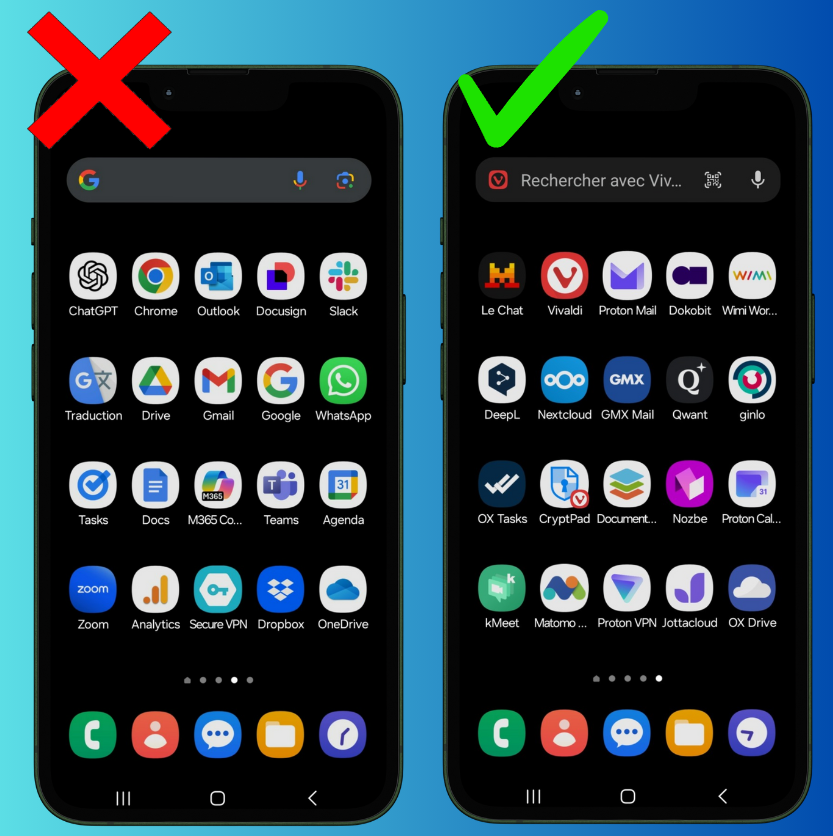
According to the most widely used apps on our smartphones and the European Parliament’s latest resolution on European technological sovereignty and digital infrastructure, the EU relies on third countries for over 80% of its digital products, services, infrastructure and intellectual property. Given the geopolitical uncertainty and the looming ‘polycrisis’, the digital transition of our economies and our information space could therefore have a decisive influence on the future of our continent.
Following a UEF resolution on the subject and the petition launched by the UEF’s Europe Group and Graspe, this meeting will seek to further the debate, following the European Commission’s unveiling of its package on European technological sovereignty on 3 June. Between the difficulty of immediate decoupling, the promotion of both open-source and private-sector initiatives, a better understanding of existing alternatives and the challenges that remain to be addressed, what can every European citizen already do to support European digital sovereignty?
With François Leray, a member of the UEF Executive Committee and the UEF Europe Group, an associate professor and senior executive in the field of communication and information technology.

| Conference in French 12 June, 12.45 pm Direct taxation in Belgium Quick link to the conference… |
U4U is offering two lectures in French, which will also be delivered in Spanish. The first will focus on direct taxes.
We will spend some time discussing the Chefquet judgment, C-119/24, concerning the Belgian 7% surcharge applied to non-residents.
Another lecture will cover indirect taxes.
| 12 June | 12.45 pm | Jérôme Noël | Belgian taxation: direct taxes In Spanish : 2 October |
| 9 September | 12.45 pm | Julien Limet | Belgian taxation: indirect taxes In Spanish : 16 October |
With
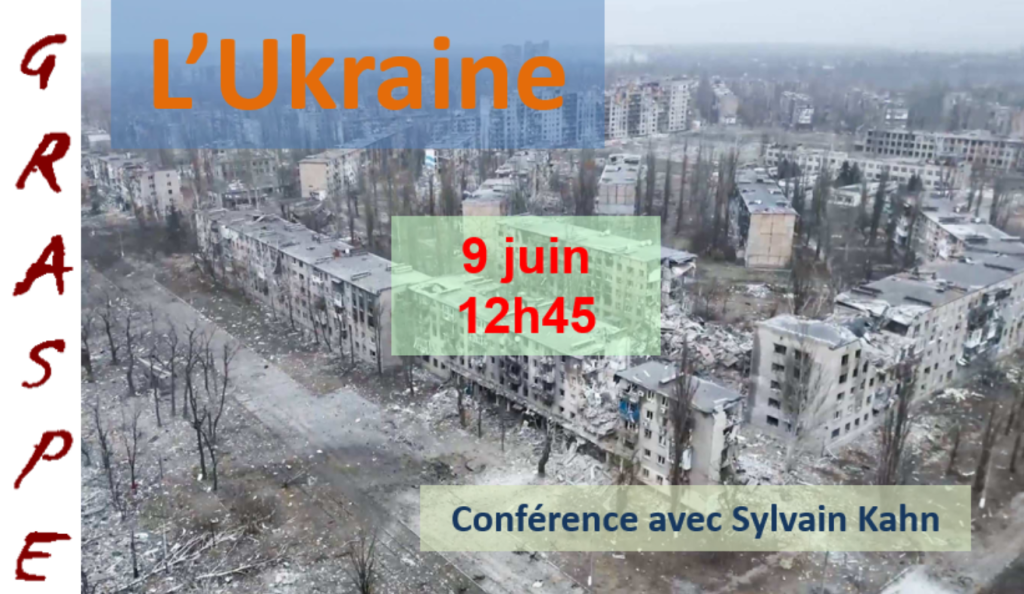
Conference in French : “Ukraine”
9 June at 12.45 pm
The presentation will be delivered in French, and questions are welcome in both English and French. There will be no recording, but a verbatim transcript will be published in GRASPE.
In Europe and the Ukraine Crisis (2024), Sylvain Kahn recounts the transformation of the European Union. Whilst the EU is not waging war, it is actively engaged in the conflict by supporting Ukraine, the victim of aggression, and imposing robust sanctions on Russia, the aggressor. This confrontation with the violence of the Russian state highlights the EU’s political uniqueness and appeal, but also its agility and responsiveness. It signals just as much that Europeans are staking their future on resilience and independence in a world of brutal powers.
As the Russian war shows no sign of abating and Trump’s United States abandons the Europeans, is the EU growing stronger or becoming vulnerable?
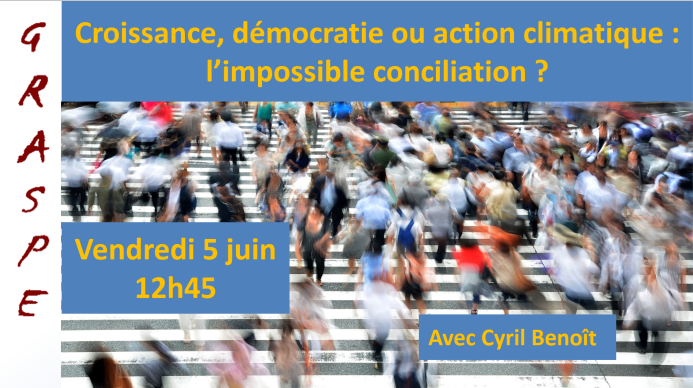
Conference in French: Croissance , démocratie ou action climatique: l’impossible conciliation ?
Friday 5 June
12.45 pm
The presentation will be delivered in French, and questions are welcome in both English and French. There will be no recording, but a verbatim transcript will be published in GRASPE.
Summary of the presentation
Western nations are currently facing a major challenge: they must simultaneously sustain economic growth, maintain their democratic legitimacy and address the climate emergency. Yet these three objectives are increasingly coming into conflict with one another. Continued growth makes it more difficult to achieve the necessary reduction in emissions; ambitious ecological planning is incompatible with electoral volatility; and a break with the imperative of growth seems difficult for the majority of the population to accept.
Drawing on a presentation of the book Growth, Democracy or Climate Action (Agenda Publishing, 2026), my presentation will analyse the tensions arising from these incompatibilities and outline several approaches to managing the transition. In particular, I will argue that, whilst we may not be able to overcome them entirely, our societies can to some extent manage the constraints of this trilemma – provided, however, that the transition ceases to be seen as an external constraint and becomes the project of a broad social coalition. This requires fully acknowledging the fundamentally political nature of the climate crisis, and what this implies for the way we concretely envisage redistribution and the role of the state today.
Bio
Cyril Benoît, PhD in Political Science, is a CNRS researcher at the Centre for European Studies and Comparative Politics at Sciences Po, and academic director of the Politics and Public Policy programme at the School of Public Affairs. His work analyses how political institutions shape economic transformations in advanced democracies. He is co-author of *Growth, Democracy or Climate Action? The New Trilemma of Advanced Capitalism (Agenda Publishing, 2026), with Aidan Regan, Hanna Schwander and Tim Vlandas.
Tim Vlandas, co-author and lecturer-researcher at the University of Oxford, will be present at the debate.
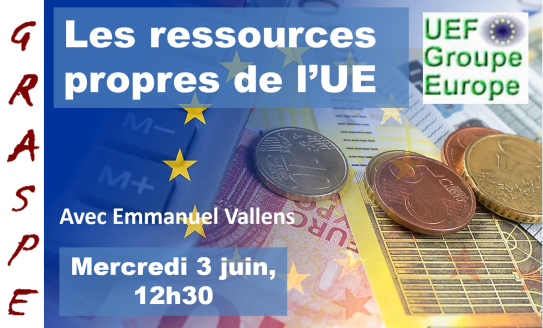
Conference in French Wednesday 3 June at 12.30 pm
Quick link to the teleconference…
The presentation will be delivered in French, and questions are welcome in both English and French. There will be no recording, but a verbatim transcript will be published in GRASPE.
This presentation will provide an introduction to the concept, its history and its current relevance within the context of the MFF.
Mr E. Vallens is a member of the Europe Group’s Working Group on the CFP.
PROMOTION EXERCICE 2026
Conference in English
02/06/2026
Appeal of promotion
Should I stay or should I go?
Online workshop (02/06/2026- details at the bottom of the page)
On 11th June 2026, the promotion proposals decided by the Directors General and Heads of Offices will be published in Sysper.
We hope that the result of those will be satisfactory for you.
As a matter of reminder, these decisions are based on the comparisons of merits between colleagues of the same staff category (SC, AST, AD) and grade in the same DG or Office.
The elements taken into account for these comparisons are the performance of the staff member (more precisely, the ability, efficiency and conduct), the use of languages at work (it is not about how many languages you can speak, but about how many of them you actually speak at work) and the level of responsibility (not only managerial responsibility, but also, for example, financial responsibility, responsibilities in the domain of security, etc.).
The comparison of merits is not done only for the year of your last evaluation (2025) but also for all the years since the last promotion was received. For example, if you received your last promotion in 2022 (with effect to the 1/1/2022), the years 2022, 2023, 2024 and 2025 will be taken into account for your promotion in 2026.
Several guarantees exist in order to ensure the fairness of the process.
During the past month, for example, representatives of the staff committee have met with the Directors General and the Heads of Office to comment their choices of proposals for promotions and ensure that all colleagues are treated fairly. Sometimes, based on these comments, the promotion lists were modified, sometimes not.
The so-called “appeal” procedure is the second of the guarantees aimed at ensuring fairness in the promotion process.
The appeal must normally be filed within 5 working days following the date on which the proposal from your Director General or Office Director was communicated to you, that is, no later than 18 June 2026.
This period is suspended and extended if you are absent for a justified reason during the relevant period (for example, on leave or absent for health reasons). If you are sick on 11 and 12 June, for example, your deadline is postponed by 2 working days, namely to 22 June 2026 (the two working days following 18 June 2026 being Friday 19 June and Monday 22 June).
The first thing to say about the “appeal procedure” is probably that it is in no way an “appeal” in the legal sense of the term. Filing an “appeal” for your promotion is indeed not saying that the decision of your Director-General was “wrong”, but it is simply a request that your case is reconsidered for the attribution of the quotas (5% of the total number attributed to all DGs) that are reserved for attribution across the whole Commission Staff.
Understanding this is of foremost importance as the chances to “win” your appeal will probably be extremely low if you insist on the reasons why you consider that you were not well treated or why you should have received the promotion instead of another colleague.
The “appeal” procedure is indeed NOT about doing a new comparison between the merits of the colleagues inside of your DG but it is, on the contrary, a completely new exercise of comparison of merits for each category of staff and grade, this time between all the staff of the Commission who have appealed (and a couple of others, as there are also some other ways – that we will briefly explain during the conference – to be considered at the appeal phase).
This means that in a good appeal file, you should mainly insist on the various elements taken into account for the comparison of merits (ability, efficiency and conduct; use of language at work ; level of responsibilities) for all the years since your last promotion.
A last important thing: you have five working days after the communication of the list of colleagues proposed for promotion to file your appeal
To explore this more in details and receive our advice for an outstanding appeal file, we invite you to the conference (open to all) we organize online in English
on the 2 June at 12.45.
You can join us through this link
https://u4unity.webex.com/meet/eco
For privacy and data protection reasons, the meeting will not be recorded.
If you cannot join, you still have the possibility to consult our vademecum
Evaluation-Promotion-VADEMECUM-U4U-en.pdf
Or join us for the presentation in French on 12 June
Information and discussion meeting with staff
Luxembourg: Your Priorities
Join us on 20 November 2025 at 12:45 pm to discuss it with us.
Link: https://u4unity.webex.com/meet/jps
A few weeks ago, we invited you to complete a questionnaire about your priorities regarding your working conditions at the European Commission in Luxembourg over the coming years.
You can still respond if you wish:
https://ec.europa.eu/eusurvey/runner/PulseLuxembourg2025 .
We now want to take this a step further and discuss the results with you.
At U4U, we believe in the value of collective deliberation and debate, and of enriching our ideas through dialogue.
With the local staff committee elections now underway and new priorities to be set in the coming months, now is the time to exchange ideas.
Let’s meet on Thursday, 20 November for what promises to be a rich and exciting discussion.
U4U supports the peace efforts of the women of Women Wage Peace (Israel) and Women of the Sun (Palestine).

| Invitation: Israeli and Palestinian women in Brussels to raise the voice of peace (17-19 Nov. 2025) A ceasefire has been agreed upon, but the challenges do not stop there! For this fragile truce to turn into lasting peace, civil society – and particularly women – must be its driving force. From November 17 to 19, 2025, at the invitation of the Belgian Support Group, Brussels will host Palestinian representatives from Women of the Sun and Israeli representatives from Women Wage Peace. These two movements, which bring together more than 55,000 women, share a common message: “A just and lasting peace cannot be built without women at the negotiation table.” 🕊️ Three days of events in Brussels in their presence: (registration required!) 🗓️ Monday, November 17, 2025 – 4:30 PM to 6:30 PM📍 European Parliament “The Role of Civil Society in Conflict Resolution – Perspectives of Women Peacebuilders in Israel and Palestine” Conference under the auspices of Chloé Ridel (S&D) and supported by Maria Walsh (EPP), Villy Søvndal (Greens) and Cynthia Ní Mhurchú (Renew). The moderator Gina McIntyre will provide insights from the Good Friday Agreement that secured peace in Ireland. European Parliament registration link 🗓️ Tuesday, November 18, 2025 – 6 PM to 8 PM📍 Chapel for Europe”Together, Israeli and Palestinian Women Dare for Peace” Four Israeli and Palestinian women will share their field experiences in the presence of four religious dignitaries – Catholic, Jewish, Muslim, and Protestant – who will share their vision of peace and sign the Mothers’ Appeal. A musical interlude by internationally renowned flutist Marc Grauwels will mark this moment with a breath of harmony. Registration link Chapel for Europe 🗓️ Wednesday, November 19, 2025 – 5 PM to 7 PM📍 Belgian SenateSigning of the Mothers’ Appeal by Belgian female politicians from all political backgrounds. Through this gesture, Belgian female politicians aim to give visibility to these two organizations, which together bring together more than 55,000 members. Their message is clear: a just and lasting peace for both peoples cannot be built without women at the negotiation table. They call for a future based on peace, freedom, equality, and security for both peoples and to break the cycle of hatred and violence. Registration link Belgian Senate If you wish to financially support the work of WWP and WOS, you can also do so by participating in this crowdfunding campaign. |
Fake news: can we protect ourselves from it?
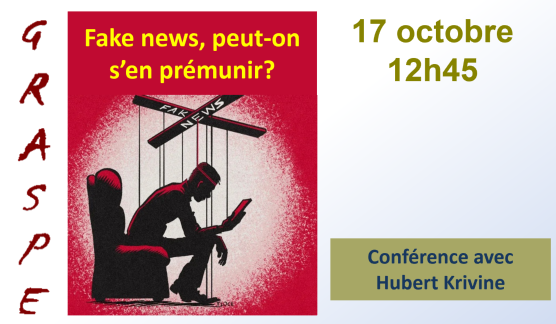
17 October at 12:45 p.m.
Conference in French
Link to the conference: https://urldefense.com/v3/https:/u4unity.webex.com/meet/jps;!!DOxrgLBm!GFah4UUnRULkF1Z5pfQRHSx0kGW3szA5Sty7qiwl1h9tf9TCVF_-6ueRNcRbULNrQH_A7gdHPyx-unPcDQjF7w4YqvcpEfOdlqkYdy1gYCCtchl7Ow$
We all need to believe, but in what?
In creationism, in the Nazification of Ukraine, in the anti-vaccine theories of US Secretary of Health F. Kennedy Jr., in the remedies of Professor Raoult, in the Nazification of Ukraine, etc. Rumours, beliefs and scams, often fuelled by ignorance, complacency or self-interest, are intimately linked to the history of humanity. And they persist, now relayed and fantastically amplified by social media. Fake news is everywhere.
Is it possible to protect ourselves from it? How can we disentangle the grain of truth hidden at the heart of every deception?
Speaker: Hubert Krivine, emeritus senior lecturer at Pierre and Marie Curie University, where he taught statistical physics. He is also the author of several books on the construction of scientific thought.
Is further enlargement of the EU still possible?
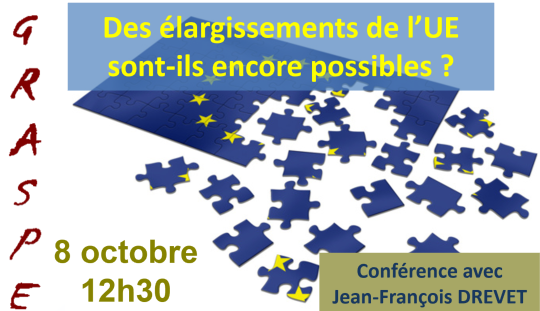
8 October at 12:30 p.m.
Conference in French
With Jean Francois DREVET, former senior civil servant, member of the Graspe editorial board, columnist for Futuribles magazine, author of books on this subject.
Link to the conference : https://urldefense.com/v3/https:/u4unity.webex.com/meet/jps;!!DOxrgLBm!Bs6xkhqI7vp7v0njeB0mVcGf7xLf1D2gmJ8X3iKakIpmaRSVG5sF-BYpDO6oTDo6MEZamxAj9LbZS1aQ1IvXMCP4_LnoUjYUQdllo19Tsix19-uaEg$
AI, intelligence without thought?

Conference in FR
Friday 27 June, 12:45
Hubert Krivine is an emeritus lecturer at the Université Pierre et Marie Curie, where he taught statistical physics. He is also the author of several books on the construction of scientific thought.
Mr Krivine has published works such as L’AI peut-elle penser, Comprendre sans prévoir, prévoir sans comprendre and ChatGPT, une intelligence sans pensée, which examine the nature and limits of artificial intelligence. His intellectual commitment has been recognised by the award of the Prix d’Epistémologie by the Académie des Sciences and the Prix de l’Union Rationaliste, underlining the importance of his work in critical reflection on science and technology.
During this conference, we will explore the strengths and limitations of generative artificial intelligences. We will take a closer look at the way in which they operate, to better understand how their logic differs fundamentally from that of humans. This reflection will also be an opportunity to look to the future to better anticipate the upheavals that the integration of AI could cause in our societies.
Understanding the technical, economic and social challenges of this coming revolution is important not only for employees and their representatives, but also for society as a whole. We need to prepare ourselves in a more enlightened way to take advantage of this technology in a constructive and non-alienating way.
Rules and limits in our daily life with our children
A conference for parents in partnership with the School of Parents in Luxembourg
June 19 from 12:30 p.m. to 2:00 p.m.
Online conference in English for parents:
https://u4unity.webex.com/meet/jps
From an early age, we are surrounded by rules. In everyday life, as well as in our relationships with our children, there are many situations in which we need to consider our own boundaries and those of our children. ‘Should we set limits?’ Should I regulate everything? Isn’t this going too far?” Don’t children need a lot of freedom?” What are the possible consequences?” And if all this doesn’t work, what can I do?”
Speaker: Patrice MOES-GRETSCH, Graduate educator, systemic family therapist, systemic parental coach
Co-parenting, let’s stay parents.
Did you know that there are tools?

A conference for parents with the “Centre de Médiation” in Luxembourg
3 April from 12:30 p.m. to 2:00 p.m.

Online conference in French for parents:
https://u4unity.webex.com/meet/jps
How do you stay a parent when you’re no longer married? Separation / divorce often has emotional consequences for parents and children of the separated couple. This raises a number of questions: how to tell children/young people that their parents are separating; what needs children / teenagers have when they separate; what reactions children / teenagers have; what attitudes/reflexes need to be adopted to ensure that things go as smoothly as possible; and so on.
In such a context, co-parenting mediation can be useful, if not beneficial.
Speaker: Paul DEMARET, Head of the Mediation Centre in Luxembourg
Mental Health: What is the link between anxiety disorders and substance-related disorders?
A conference for all in partnership with the Centre National de Prévention des Addictions in Luxembourg
March 26 from 12:30 p.m. to 2:00 p.m.
Online conference in English:
https://u4unity.webex.com/meet/jps
Anxiety is the most common mental health problem. For example, it is the number one reason people do not go to work. Teenagers and children are also affected by anxiety, but the symptoms are different.
If you want to know more, join our conference!
Speaker: Sacha BACHIM, psychologist and psychotherapist in Luxembourg
U4U Lunchtime Conferences (week of February 17-21)
- Tuesday 2/18 at 12:45 PM – Assessment Report: Should I Appeal?
- Wednesday 2/19 at 12:45 PM – Moral Harassment: What if the Tree of Individual Behaviors Hides the Forest of Organizational Inadequacies?
- Thursday 2/20 at 12:45 PM – A survey about the JSIS and How It Works
Tuesday 18/2 at 12:45
Evaluation report: should I appeal?
As we promised, we continue to support you in monitoring the evaluation and promotion processes. If, in January, we advised you on writing your self-evaluation, we now propose to explain to you what the appeal procedure for the evaluation proposed by your manager consists of and to explore with us whether this procedure may be of interest to you.
Consult our evaluation and promotion vade-mecum: Evaluation-Promotion-VADEMECUM-U4U-en.pdf
Wednesday 19/2 at 12:45
Moral harassment: what if the tree of individual behaviors hid the forest of organizational shortcomings?
U4U has never stopped reminding it: moral harassment at work is not only the result of individual behaviours. It is also, and perhaps above all, a question of organizational climate and general shortcomings in the organization of work.
In a recent judgment (appeal no. 22-87.145), the criminal division of the Court of Cassation of the French Republic admitted, in its own words, that “The directors of a company can be criminally sanctioned for having committed ‘institutional moral harassment’, that is to say resulting from a company policy leading, with full knowledge of the facts, to the deterioration of the working conditions of employees.
We invite you to discuss together how this development of case law in a Member State should inform our thinking on the issue of harassment in our institutions.
Read the press release of the Court of Cassation of the French Republic (in French):Communiqué: Reconnaissance du harcèlement moral institutionnel | Cour de cassation
Thursday 20/2 at 12:45 p.m.
A survey of the JSIS and how it works
The JSIS (Joint Sickness Insurance Scheme) is the compulsory health insurance system (covering in particular sickness, accidents and maternity) for officials and staff of the European institutions, established on the basis of Article 72 of the Staff Regulations.
It was set up to ensure that all staff members of the institutions, regardless of their nationality or country of residence, enjoy equivalent protection and access to health care.
Financed by our contributions (whether our direct contributions, deducted from our salary or the share paid by the institutions which also constitutes an indirect salary that is ours by right), the JSIS is the common good of all staff members of the European institutions. This remains true, even if the regulations provide that many decisions relating to this scheme are taken by the AIPN or by the College of Heads of Administration.
On a daily basis, it is administered by a dedicated and competent team, attached to the PMO, and managed by a management committee composed of representatives of the staff and administrations of the various institutions concerned.
While many developments are underway at the JSIS (computerization and automation of services, negotiation of agreements to regulate interactions with national health services, development of new innovative medical techniques that were not originally provided for in the regulations) and recurring questions arise (calculation of equality coefficients to take into account differences in health care costs in various countries, management of surpluses and deficits, etc.), it was time to take the pulse of how staff perceive their relations with this system?
How do you manage with the online systems offered by PMO? What is your assessment of the level of reimbursement and the ceilings applied? Do you understand the statements of reimbursement sent to you? Are you aware of the possibilities for additional reimbursement in the event of significant expenses? And the rules regarding the coverage of hospitalization costs or other major expenses? Those regarding prior authorizations?
These are all questions that we asked staff and retirees in a questionnaire that remained open for a full quarter (it is still possible to answer it if you have not done so) and has received more than 6,000 responses so far.
In this conference, we will share the first results of our survey and discuss them with you.
To answer the questionnaire if you have not yet done so: https://ec.europa.eu/eusurvey/runner/Enquete-RCAM?surveylanguage=EN
Look on the emotional needs of
the child
A conference for parents with the “Ecole des parents” in Luxembourg
February 13 from 12:30 p.m. to 2:00 p.m.
Online conference in French for parents:
https://u4unity.webex.com/meet/jps
What does a child try to express with a disturbing behaviour? Which fundamental need he tries to satisfy? From a parent point of view, there’s an art to taking your child’s needs into account, giving them the freedom to express and develop themselves. It is by looking at the emotional needs of a child that we can find keys not only to resolve many family situations but also to allow the child to feel heard and taken seriously.
Speaker: Silvia Del Guerzo, graduate educator, counselling therapist
If you appreciate our work, please consider becoming a member of U4U.
 Conferencia sobre fiscalidady estrategias fiscales clave, presentada por un experto en el ámbito internacional  22 de enero 12:30 a 14:00. Video-conferencia en español: https://u4unity.webex.com/meet/jps |
| Explicaremos las particularidades del régimen fiscal de los funcionarios y agentes de la Unión Europea, centrándonos en:La determinación de la residencia fiscal según el Protocolo de Privilegios e Inmunidades.Las posibles controversias con las administraciones fiscales nacionales y cómo afrontarlas.Recomendaciones prácticas para optimizar su situación fiscal por ejemplo en cuestión de herencia.Únete a nosotros.Conferenciante: Victor RIERA es Doctor en Derecho por la Universidad de Alicante, Víctor Riera es el fundador y director de Riera Consulting, con más de 20 años de experiencia en el ámbito de la consultoría y asesoramiento tributario. Su tesis doctoral trata de la tributación de los funcionarios y agentes de las instituciones de la Unión Europea.Esta conferencia está diseñada para resolver sus dudas y aclarar las complejidades de este régimen tributario único, con ejemplos prácticos y una sesión de preguntas y respuestas en directo.¡Aproveche esta oportunidad para enriquecer sus conocimientos y aclarar cualquier inquietud sobre su situación fiscal! |
| Si vous appréciez notre travail, svp, envisagez de devenir membre d’U4U. If you appreciate our work, please consider becoming a member of U4U. |
| ||||||
| « Travailler comme ingénieur avec un contrat de secrétaire ?» : il faut faire cesser le dumping social ! | “Working as an engineer with a secretary contract?”: we must stop social dumping! | |||||
Avec la dégradation des marchés de l’emploi dans les États membres de l’Union européenne, il n’est malheureusement pas rare que des personnes titulaires de diplômes universitaires ou de qualifications techniques d’un niveau élevé soient contraintes d’accepter des emplois très en-dessous de leurs niveaux de formation ou d’expérience. Dans les institutions de l’Union européenne, on peut rencontrer des collègues engagés au niveau AST/SC ou contractuel de groupe de fonction I ou II, qui expliquent qu’ils exercent des fonctions réclamant des qualifications académiques ou techniques très supérieures à ce qui correspond normalement à ce type de statut.  Afin de prendre la mesure de ce phénomène et de demander à engager un dialogue social sur ces questions, nous vous invitons à venir partager vos expériences sur ce genre de situations avec nous lors d’une réunion d’échange de vues qui aura lieu dans notre salle de réunion située au 1er étage du bâtiment J70 de la Commission européenne (Rue Joseph II 70, 1er étage, bureau 1/140) le mardi 21 janvier 2025 à partir de 12h45. Il sera aussi possible de se connecter en ligne en utilisant ce lien : https://u4unity.webex.com/meet/jps Lors de cette réunion, nous prendrons note de vos expériences personnelles à ce sujet (soit que vous soyez vous-même victimes du dumping social, soit que vous ayez observé des situations de ce genre autour de vous) afin de préparer notre dossier de négociation. Nous espérons vous y voir nombreux. | With the deterioration of the job markets in the Member States of the European Union, it is unfortunately not uncommon for people with university degrees or high technical qualifications to be forced to accept jobs well below their level of training or experience. In the institutions of the European Union, it is possible to meet colleagues employed at AST/SC level or contract agents in function group I or II, who will explain that they are performing duties requiring academic or technical qualifications well above what normally corresponds to this type of status.  In order to take stock of this phenomenon and to request that a social dialogue be initiated on these issues, we invite you to come and share your experiences of this type of situation with us during an exchange of views meeting which will take place in our meeting room located on the 1st floor of the J70 building of the European Commission (Rue Joseph II 70, 1st floor, office 1/140) on Tuesday 21 January 2025 from 12.45. It will also be possible to connect online using this link: https://u4unity.webex.com/meet/jps At this meeting, we will take note of your personal experiences on this subject (whether you are yourself victims of social dumping, or you have observed situations of this kind around you) in order to prepare our negotiation file. We hope to see many of you there. | |||||
| Si vous appréciez notre travail, svp, envisagez de devenir membre d’U4U. If you appreciate our work, please consider becoming a member of U4U. | ||||||
Avec G.J. Koopman, DG BUDG
conférence 1/4 du 24.11.20, Avec Fanny Lederlin, auteure du livre Les dépossédés de l’Open Space aux éditions Filigranes.
Premier épisode de notre cycle de quatre conférences sur le thème : De l’open space au télétravail, réflexion critique sur le travail au XXIème siècle.
conférence 2/4 du 01.12.20, Avec Fanny Lederlin, auteure du livre Les dépossédés de l’Open Space aux éditions Filigranes.
Deuxième épisodes de notre cycle de quatre conférences sur le thème : De l’open space au télétravail, réflexion critique sur le travail au XXIè siècle.
conférence 3/4 du 08.12.20, Avec Fanny Lederlin, auteure du livre Les dépossédés de l’Open Space aux éditions Filigranes.
Troisième épisode de notre cycle de quatre conférences sur le thème : De l’open space au télétravail, réflexion critique sur le travail au XXIème siècle.
Dernier épisode de notre cycle de quatre conférences sur le thème : De l’open space au télétravail, réflexion critique sur le travail au XXIème siècle.
- Février 2021 : Webinaire Graspe / Greentervention avec Laurence Scialom : Finance et transition climatique
- 29 janvier 2021 : Politique de vaccination contre la COVID du personnel de la Commission. Conférence organisée par le Comité du personnel de la Commission à Bruxelles.
- 2020 : Quatre conférences sur le télétravail : 1 2 3 4
- 29 Sept 2020 : Populismes, démocratie, Europe avec Jerome CREEL (OFCE), Lewis DIJKSTRA (REGIO), Marie-Hélène CAILLOL (LEAP)
- 9 March 2020 : Biodiversity and ecosystem services are in emergency : What the science says and what transformative policies can do
- 6 March 2020 : A COMPASS FOR THE 21ST CENTURY – WHY THE DOUGHNUT IS IMPORTANT FOR TRANSFORMATIVE R&I POLICY
- 4 mars 2020 : Prochain Budget de l’Union européenne: où en sommes-nous? (mot de passe : ghfG83kJH)
- 26 mai 2020 Laurent Berger est le secrétaire général de la Confédération française démocratique du travail (CFDT) depuis le 28 novembre 2012, et le président de la Confédération européenne des syndicats (CES) depuis 2019.
Other public conferences
- Pour une relance du dialogue social européen, par Laurent Berger (26 mai 2020) : Dans cet entretien, il revient sur la crise consécutive à l’épidémie de COVID et évalue ses conséquences économiques et sociales, ainsi que la réponse apportée par les institutions européennes. Il esquisse les contours d’un syndicalisme européen s’épanouissant dans le cadre d’un dialogue social qu’il faut réinventer au plus vite pour faire face à la crise afin de relancer l’UE en vertus d’objectifs bien identifiés : »Demain l’enjeu c’est un modèle économique plus juste et respectueux de l’environnement, avec donc une inscription délibéré dans la transition écologique. L’enjeu c’est aussi la lutte contre les inégalités, qui minent notre pacte social et républicain, mais aussi le projet européen, car la défiance à son égard croît dans le terreau des inégalités. Et enfin, c’est la volonté de faire tout cela dans un cadre démocratique. »
- Conférence avec Filipe Marques (2 Mai 2020) : Filipe Marques est un juge portugais et est le président de MEDEL (Magistrats Européens pour la Démocratie et les Libertés), une association qui promeut les droits fondamentaux et l’Etat de droit et qui regroupe 23 associations nationales de magistrats, juges et procureurs issues de 16 États européens, et qui représente 18 000 magistrats. Il revient dans cet entretien sur ce qu’il qualifie de démantèlement de l’Etat de droit à l’oeuvre en Hongrie et en Pologne, et explique les réponses que les institutions européennes et la Cour de justice de l’Union européenne (CJUE) ont apportées à ce problème qui menace les valeurs sur lesquelles repose l’Union européenne. Il explique également comment la CJUE est celle qui, par ses décisions, permet de réagir dans l’UE face à certaines dérives à l’oeuvre dans certains Etats, quand la volonté politique des pays membres manquent ou qu’il ne sont pas en mesure d’agir. Elle participe ainsi à la construction d’un cadre juridique européen qui s’apparente à une “constitution judiciaire” européenne.
- Conférence avec Shahin Vallée (22 avril 2020) : La vidéo fait partie d’une série sur l’Europe au temps du coronavirus. Shahin Vallée, chercheur au Conseil allemand des relations étrangères (DGAP), y explique comment la mutualisation monétaire implique pour les Etats de la zone Euro de consentir à mutualiser et monétiser nos dettes, et que le moment est venu de le faire dans le contexte de la crise économique résultant de l’épidémie de COVID-19. Il s’agit d’assurer l’avenir de l’UE, pas moins. Les 27 doivent donc parvenir à s’entendre sur ce principe. Si tel n’est pas le cas, un groupe de pays plus restreint, une “coalition de bonne volonté”, devrait pouvoir le faire à sa seule échelle pour l’instant.
Other interesting conferences
Groupe de Recherche sur l’Union européenne GrUE – La fonction publique européenne par Didier Georgakakis (9 octobre 2020)